
The trail started out very clearly trodden, even though blanketed with a recent layer of leaves. Every so often a white, spray-painted mark on a tree would confirm that we were still on track, even after climbing over tree trunks that lay across the path and sloshing through pools of mud (some subtly concealed until stepping into them). Then we reached a point where there was no clear direction forward. Off to the right appeared to be an overgrown path down toward the creek, but that did not seem to lead us to our intended destination. I went back to the place where the trail became less evident, and found a white mark on one of the trees as would be visible to someone coming the opposite direction. That provided 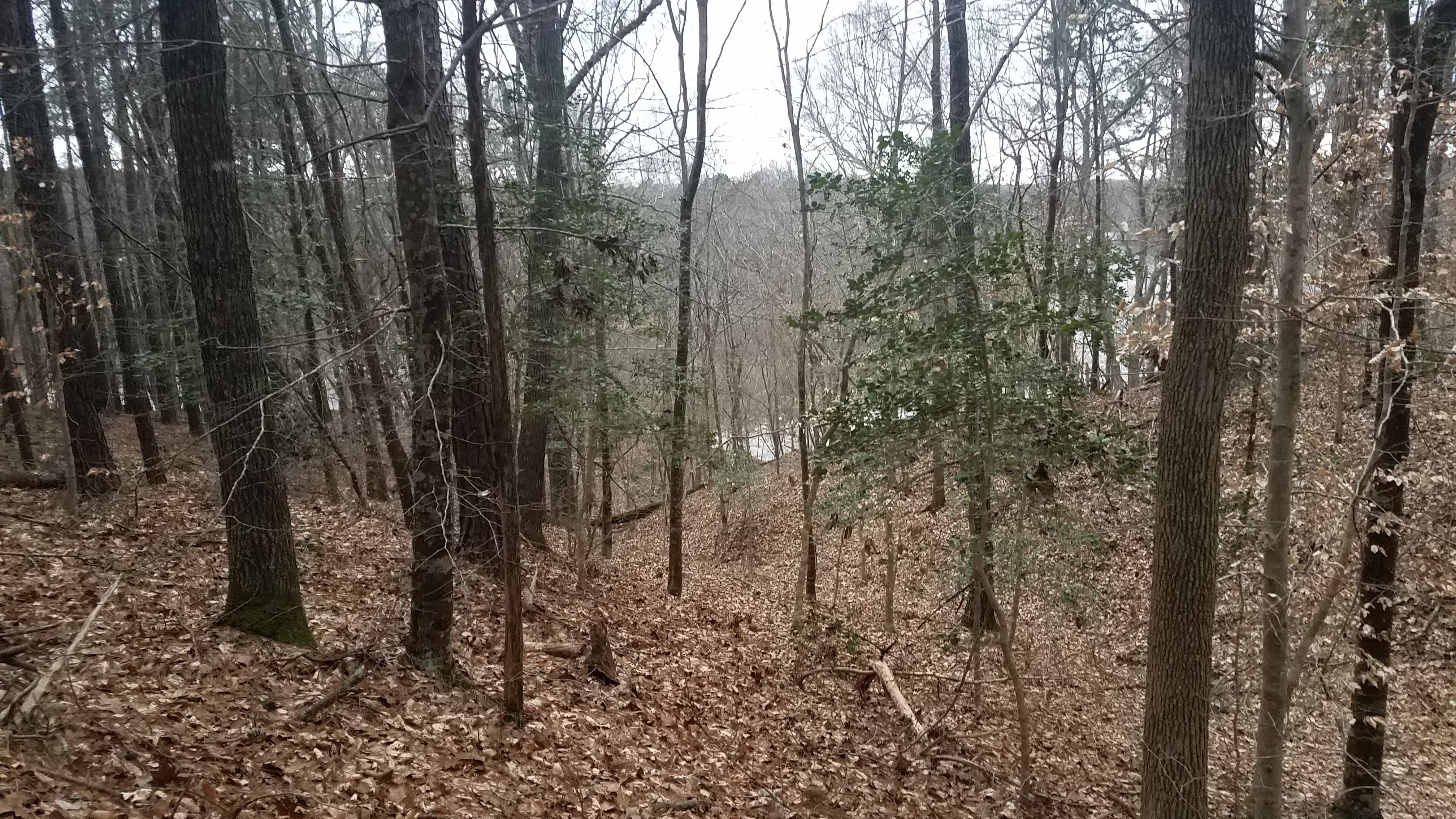 the general angle of approach, and after scanning past trees and pushing aside branches, I saw another white mark. My cell phone rang; my husband, who had explored the side path until being attacked by thorny branches, asked where I was and if I’d found the trail. I told him to come back to where it split. We had the general trajectory, and spent the next fifteen minutes walking a little way, then again reexamining our direction, starting to move forward, then searching for another marker, or an alternative way to get past briers and muddy trickles of water. In some areas where there were a couple of seemingly viable options, markers were placed closer together and helped us choose the correct route. Occasionally we would pull out the GPS to see if we were headed in the right general direction, even though the path itself was not visible on the map.
As we walked, I thought about the similarities to our life walk. There are times when the path seems clear, despite an occasional hurdle. It is when there appears to be no clear route that we stop and search for direction. When walking for some time without seeing any signs, we question if we’re on track, if we’re going the right direction. When getting tangled in branches of distraction or sinking into the mud of messy details, we have to make sure we’re not getting lost. The destination is already set, but without seeking markers, we could easily veer off and find ourselves at an impasse.
Looking at the white markers, it also occurred to me that we were walking by faith. We knew nothing about the source of those marks, who put them there, how reliable they would be, or what their true purpose was. We simply assumed, by faith, that someone had marked those trees with our best interest in mind, to guide us toward our intended destination. There was no way to “prove” the existence of such an entity (although the unlikelihood of white marks appearing on trees by chance was easy to defend), nor could we be sure of the destination prior to arrival. How were we to know it wasn’t a prank taking us to a horrible trap? Again, there was no reason for such pessimism, but there was a certain degree of blind trust when walking through areas where no clear trails were evident. Fortunately, those white markers successfully guided us to the end of the trail, proving their integrity.
Reflecting on the parallels with life, I came up with two applications: the ultimate destination and the uncertainty of decisions. Choose your own conclusion and comment on it below!
Uncertainty in Decisions

Ultimate Destination
ultimate destination. both are good, but I related more to your personal illustration of physical suffering with the neurological illness. Stories and biography speak to me more. Well done. I miss hiking, and felt like I was out there lost in the forest too!
Thanks so much for commenting, Denise! Your words mean a lot to me. Blessings to you as you keep your eyes fixed on Him!
I can also relate to both, as I feel like there are seasons in ones life where the path is full of those physical struggles, and then there are those times when we are more goal-driven. For myself I struggle with the why’s and for how longs or is this your plan or mine, but as I season, I find myself recovering from those crises more quickly. I am able to lean on my faith, remember to cast my worries upon Him, and be comfortable where I am.
Hi Emily!
I definitely relate to the unclear path. I resonated when you were speaking about your initial Tree of Life being completed and ready and now being in a place of not knowing what the next steps are for it. I, too, have a calling that God has placed on my heart to help those who are grieving loss and we’ve done several retreats and camps to date, however, the last two years, none. Last time I was up in the mountains where we host it, I went on an early morning walk to a place I had gone for years. When I got there, everything was different. Trees had fallen down and the path was now curved around the fallen trees, rather than a straight line to a circular pad overlooking the mountains. While I sat there, Holy Spirit spoke to me about this new, unfamiliar path, telling me that it’s okay that is is unfamiliar, because I will always be able to find Him on it with me. He is my familiar in any season where things look so different. That was so comforting and reassuring, and I am still waiting on Him to see what the next steps are while I am currently creating a “tent making business” to fund my salary when I return to the grief work.
Thank you for sharing such profound truths and questions. I believe that if we focus on Him when things are unfamiliar or uncertain. He will be our anchor and our Captain as we wait for direction. God Bless you Emily. Hope to meet you when you and Dean are here next!! I would love to hear more about the training you will be doing in September and if God permits, be a part of it!
Good observations, Emily! I like how you and Dean were able to wisely slow down the pace, taking the time to make sure you were still on course, and connecting with each other in the process. Some of us can stay so busy and distracted, that we miss opportunities to reassess our location and destination, and to make sure we’re following God’s leading. If we can learn to value the slowing, the looking, the noticing, and the listening, then we are more likely to stay tuned-in and synchronized with the Father. Well done!